
Most music promo on social media fails for one simple reason: it gets attention, but not action. If I want social media to help a release, I need a clear goal, one CTA per post, short-form video, a pre-save plan, smartlinks, partner support, and weekly tracking.
Here’s the short version:
- Pick 2–3 platforms that match the fan base instead of posting everywhere
- Set a clear artist or label identity before I publish anything
- Clean up profiles with one main link and one direct CTA
- Plan posts around release timing, especially the U.S. Friday drop
- Use short vertical video to push discovery and streams
- Post on a steady schedule without burning out
- Mix promo with fan interaction so the feed does not feel like ads
- Work with DJs, creators, and other artists to reach new listeners
- Run pre-save campaigns and smartlinks to turn interest into clicks
- Track clicks, saves, streams, and ticket sales so the next campaign improves
A few numbers show why this matters: 82% of Gen Z and 70% of millennials in the U.S. find new music through social media and user posts, and 13 of 18 Billboard Hot 100 No. 1 songs in 2023 had ties to TikTok trends. So if I want more streams, pre-saves, and ticket sales, I need a posting plan that moves people from seeing a post to doing one clear next step.
8 Music Marketing Strategies That Actually Work | Ditto Music
sbb-itb-888513b
Quick Comparison
| Tip | Main job | What I focus on |
|---|---|---|
| Choose platforms | Reach the right people | TikTok, Instagram, YouTube, Facebook, X |
| Define brand | Make the account easy to place | Story, sound, visuals, tone |
| Optimize profiles | Turn visits into clicks | Bio, pinned post, smartlink |
| Build a calendar | Match posts to release stages | Tease, pre-save, release, after |
| Lead with video | Drive discovery | 10–30 second vertical clips |
| Post steadily | Stay visible | 3–5 posts per week |
| Balance engagement | Keep fans interested | 70/30 mix of connection and promo |
| Use partners | Expand reach | DJs, creators, artist collabs |
| Push pre-saves and smartlinks | Drive action | One link, direct CTA |
| Track results | Improve each release | Clicks, saves, streams, sales |
If I keep the message simple and the path clear, social media stops feeling random and starts working like a release system.
What Good Music Publicity Looks Like on Social Media
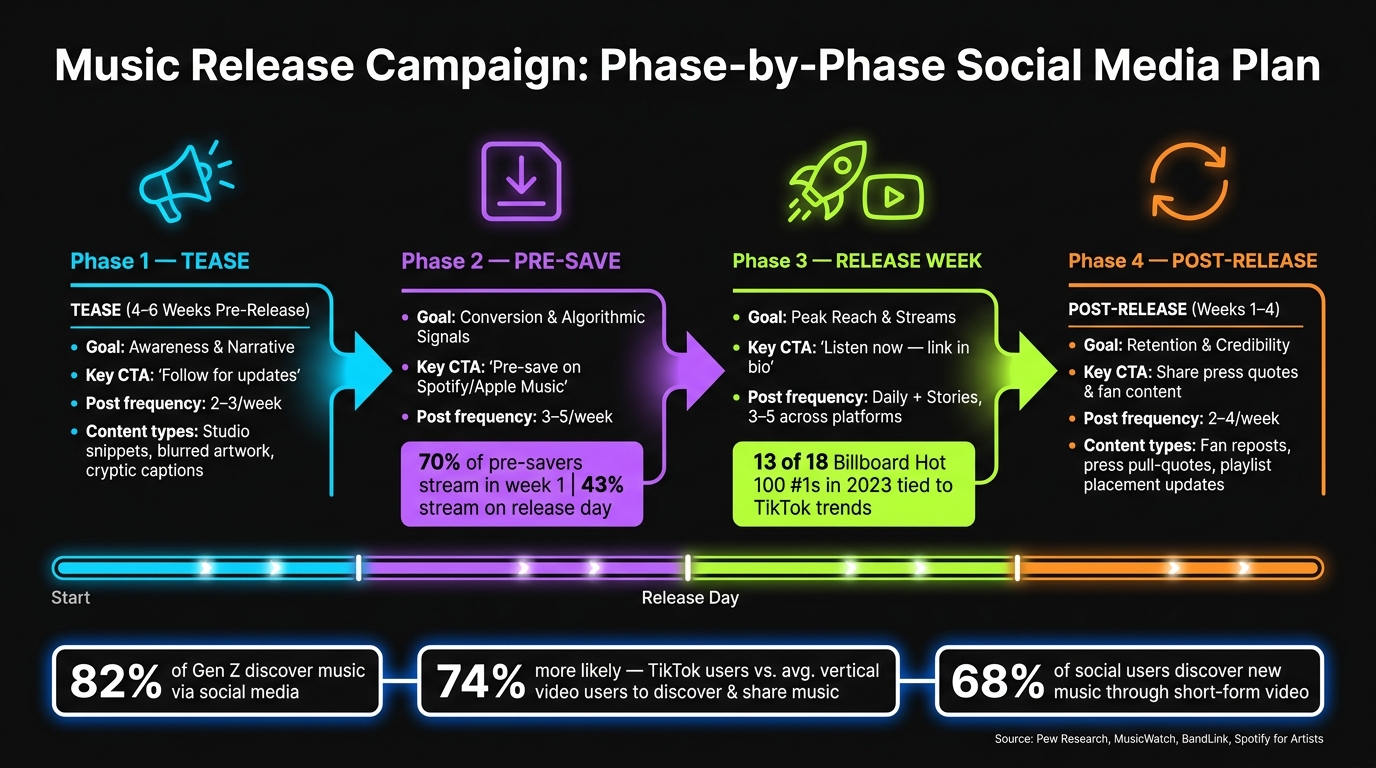
Music Release Campaign Timeline: From Teaser to Post-Release
Good music publicity uses social media to move people from attention to action. In plain English, it’s not just about getting seen. It’s about getting people to do something.
That’s why every campaign needs to be built around three things: goals, conversion, and timing.
Core Publicity Goals
Strong campaigns usually work toward five goals: awareness, narrative, credibility, retention, and conversion.
These goals connect with each other. Credibility from DJ support, playlist placements, and press quotes can strengthen awareness. Retention keeps fans around long enough to convert. And narrative gives people a reason to care in the first place. When those pieces work together, social media stops being random posting and starts working like a plan.
From Attention to Action
Each key post should have one clear CTA. Not three. Not five. Just one.
Send fans through a smartlink or another trackable link so you can see what’s working. That part matters. If you can’t track it, you’re guessing.
In one documented case, UTM tracking on Chance the Rapper‘s merchandise links showed that 60% of his merch sales came from Twitter.
Timing Around U.S. Release Cycles
Timing matters just as much as content, especially around U.S. release habits.
In the U.S., Friday is the standard release day across all major DSPs. So if you make Friday morning your biggest push, you’re walking into a crowded room and trying to shout over everyone else. Attention is already split. A better move is to build momentum before Friday, then use release day for the payoff.
For national campaigns, schedule posts in Eastern Time first, then adjust based on where your audience is most active.
Use this cadence as the baseline for every release campaign:
| Campaign Phase | Timing | Primary Goal | Key CTA |
|---|---|---|---|
| Tease | 4–6 weeks pre-release | Awareness & narrative | "Follow for updates" / behind-the-scenes content |
| Pre-Save | 3–4 weeks pre-release | Conversion & algorithmic signals | "Pre-save on Spotify/Apple Music" |
| Release Week | Friday drop | Peak reach & streams | "Listen now" / smartlink click |
| Post-Release | 1–4 weeks after | Retention & credibility | Press quotes / fan content shares |
1. Choose the Right Social Platforms for Your Audience
Once your publicity has a clear CTA, the next step is deciding where that CTA should show up. You do not need to post everywhere. In most cases, it makes more sense to focus on two or three platforms your listeners already use.
Audience Fit
Audience fit matters more than platform size. Pew Research‘s 2025 data shows that 84% of U.S. adults use YouTube, compared with 71% for Facebook, 50% for Instagram, and 37% for TikTok. That tells you something simple but important: each platform reaches a different group of people.
As a rule of thumb, TikTok and Instagram lean younger. They tend to work well for pop, hip-hop, R&B, indie, and electronic music. Facebook leans older and can work well for country, classic rock, and jazz acts whose fans still use it to find events. YouTube reaches people across age groups and is the best long-tail option if you want your catalog to stay searchable long after the release cycle ends.
Release Support
Each platform has a different job. TikTok works well for teaser testing. Instagram is useful for pre-saves. YouTube is the place for official videos and search traffic. Facebook still does a solid job with events and tour promotion.
Content Format
Format matters just as much as the platform itself. TikTok tends to reward short vertical video with a hook right away. Instagram leans toward Reels, photos, and Stories. YouTube usually works best for longer video. Facebook tends to do better with event posts and native video.
Conversion Potential
Watch which platform drives streams, pre-saves, tickets, and merch sales, then put more effort into the one that converts best. YouTube also helps with long-term discovery and repeat listening.
To see what’s pulling its weight, tag every link with UTM parameters and check Spotify for Artists traffic data each week.
| Platform | Best For | Strongest Conversion |
|---|---|---|
| TikTok | Discovery, short-form video, younger audiences | Streams via audio use |
| Branding, pre-saves, Reels | Pre-saves, merch | |
| YouTube | Long-form content, catalog, search | Long-term streams, loyalty |
| Events, older demographics, community | Ticket sales |
With your platform mix set, the next step is to define the brand voice and visuals that will carry across each one.
2. Define Your Artist or Label Brand Before Posting
Once you know where you’re posting, the next step is simple: decide what your content should signal. Before anything goes live, define your brand. That means your story, your sound, your visuals, your tone, and the reason fans should follow in the first place. If you run a label, add your roster focus and release culture too. That definition should shape every caption, visual, and CTA.
Start with one sentence that explains who you are, what you sound like, and why fans should care. For example: "Los Angeles-based producer blending nostalgic ’90s R&B with modern trap for late-night listeners." From there, choose 2–3 core colors, one font system, and one image style that fits your sound. The look should match the music. Think bold contrast for trap or hip-hop, or earthy tones for indie folk. Then use those same rules across cover art, teasers, Stories, and videos.
Audience Fit
A clear brand works like a filter. It pulls in listeners who connect with your sound, story, and aesthetics, while quietly pushing away people who were never going to stick around. That matters more than most artists think.
When your brand is clear, the right fans can recognize you fast. When your bio is vague, you tend to pull in mismatched followers, and that usually leads to weaker engagement.
Release Support
When your brand is written down, release campaigns get much easier to run. You already know what the cover art should look like, how teaser posts should feel, and how Stories should support the release. You also have a clear message flow: announcement, teaser, pre-save push, release day, and post-release storytelling.
That kind of structure saves time. Instead of arguing over direction every time a song drops, your team can focus on getting the work out. A defined brand also keeps promo assets and social posts aligned.
Content Format
Your brand should shape how your content looks and sounds in every format. Instagram can carry polished visuals. Stories can feel more raw and behind the scenes. TikTok and Reels can lean harder into performance or personality.
No matter where someone finds you, the editing style, color grading, and caption tone should still feel like you. A fan should be able to land on your TikTok or your YouTube channel and feel that connection right away.
"Visual consistency helps fans recognize your posts quickly." – Pete, Promoly
Conversion Potential
Consistency builds trust. In fact, 81% of consumers say they must trust a brand before buying from it, and it takes 5–7 brand interactions for someone to remember you.
That’s why your smartlink and pre-save pages should match your social visuals. Use the same artwork, the same colors, and the same tone. When everything lines up, the jump from “I saw this on TikTok” to “I pre-saved it on Spotify” feels smooth instead of awkward.
3. Optimize Profiles with Smart Links and Clear Calls to Action
Once your brand is set, your profile has to do some actual work. Think of your social profile like a storefront: if people can’t tell who you are, what you make, and what they should do next, you lose the click. The bio matters first because it’s doing the fastest job on the page.
Audience Fit
A good bio should do three things at a glance: say who the artist or label is, signal genre and scene, and tell the visitor what to do next. Include your genre, a location or mood cue, and one current priority.
For labels, the bio should also show roster identity and scene focus so visitors can tell right away whether the account fits what they follow. Example: "Indie-pop artist from Austin | New EP Friday | Listen below".
Skip vague lines like "living my dream." They don’t help fans, journalists, or playlist curators place you fast. Once the bio is clear, the link should back up that same message.
Release Support
Your profile link should change with each phase of the campaign. Switch to a pre-save page 14–21 days out, move to a multi-platform smartlink on release day, then update it again based on the next priority, like tour dates, merch, or a follow-up single. Pinned posts should match that timing so the top of your profile reflects what matters NOW.
"Pre-saves translate directly into first-week performance, which affects how platforms treat your music going forward." – Promoly
Even small pre-save numbers can matter. As few as 50–100 pre-saves can affect Spotify’s Release Radar placement for smaller artists.
Content Format
Keep the profile layout clean and easy to scan. One main smartlink in the bio, one pinned post tied to the current campaign, and story highlights sorted into categories like "New Music", "Tour", and "Press" give fans a clear path without too much clutter.
Limit visible links to five or fewer so people aren’t hit with too many choices. A simple order works best:
- Current release or pre-save
- Main streaming profile
- Merch
- Video
- Mailing list
Conversion Potential
A smartlink often works better than a single destination link because it sends fans to the platform they already use. Analytics can show which destinations convert best, which gives you a better read on what to do in the next campaign.
The CTA matters just as much. "Stream on Spotify", "Pre-save the album," or "Watch the official video" will beat a vague "New song out now". With the profile in place, the next step is building content around the next release milestone.
4. Build a Release-Focused Content Calendar
With your profile set and your smartlink ready, the next job is simple: know what you’re posting and when you’re posting it.
That’s what a content calendar does. It takes random posting habits and turns them into a plan with clear dates, formats, and goals. Once your profile is ready, the calendar decides when fans see each link and CTA. It also turns your release plan into repeatable posts that match each stage of the campaign.
Audience Fit
Before you add dates, check your platform analytics. Instagram Insights, TikTok Analytics, YouTube Studio, and other native tools show when your followers are active. Use your own numbers, not generic posting charts.
A good starting point is 3–4 posts per week, then post more often as release day gets closer. After you lock in timing, connect each post to the release phase it supports.
Release Support
Each post should match a campaign phase, not just sit on a calendar date.
| Phase | Timing | Goal | Frequency |
|---|---|---|---|
| Tease | 6–4 weeks out | Awareness | 2–3/week |
| Announcement | 4–2 weeks out | Pre-saves, follows | 3–5/week |
| Peak Hype | Final 7 days | Maximize intent | Daily + Stories |
| Release Day | Week 0 | Drive streams | 3–5 across platforms |
| Post-Release | Weeks 1–4 | Retention | 2–4/week |
Start with teaser posts early on. Then, once the link is live, shift to direct pre-save CTAs. That keeps each post focused on one job instead of turning the whole campaign into one long promo run.
Content Format
Once timing and phase are locked in, format shapes how the calendar works day to day.
For Instagram, a release week might include Reels, carousels, Stories, and one Live. On TikTok, try several short videos in a day using different parts of the song. That gives you more chances to see what clicks.
Leave 20–30% of the calendar open for reactive posts. You’ll want space for fan replies, timely moments, and milestone updates.
Conversion Potential
Deadline-based CTAs tend to drive the most pre-saves and streams. So instead of saying new music coming soon, say something direct like "Pre-save before Friday."
Plan your pre-save push to begin 3–4 weeks out. Repeat that message 2–3 times per week, then schedule a final "last chance" post 48 hours before release. On release day, switch every link from pre-save to streaming and post in multiple waves. Sync DJ outreach to those same milestones.
Done right, the calendar moves fans from teaser to pre-save to stream without dead space in between.
"Pre-saves are the closest thing to a guaranteed first-day audience." – Promoly
5. Lead with Short-Form Video
Your content calendar is set. Next up: the format that gets the most traction. Right now, that’s short-form video.
The numbers make the case. About 85% of TikTok videos contain music, and U.S. TikTok users are 74% more likely to discover and share new music than the average vertical-video user. Instagram Reels and YouTube Shorts add even more reach. For labels and artists, short-form video is the fastest way to drive discovery and publicity. The job now is simple: turn the plan into clips that stop the scroll.
Audience Fit
Each platform plays a different role, so the clip should match the feed it lands in. Use TikTok to test hooks and see what gets picked up. Use Reels to build more fan interest. Use Shorts to keep your catalog in front of people and stretch reach beyond the first wave.
Release Support
Every video should tie back to a release moment. Think of each clip as support for a specific stage.
In the 3–4 weeks before release, post 10–20 second teaser clips that spotlight the hook or chorus and push pre-saves. During release week, post multiple clips built around different visual ideas. That could mean a POV version, a lyric-style edit, or a raw performance clip, all using the official track snippet. Strong TikTok bursts can lift streaming in the following three days, so put your best posts close to release day.
After release, keep the song moving with:
- Fan reaction videos
- Live performance snippets
- Tour clips
- Remixes
Content Format
Stick with vertical 9:16 video. Keep most clips in the 10–30 second range to support strong completion rates. Open with a strong visual and audio hook in the first 1–3 seconds. If the opening falls flat, people are gone.
Add on-screen text for lyrics or the CTA, and make sure the clip works both with sound on and on mute. Use the official track snippet tied to your DSP release so platforms can connect the song to "Add to Music App" actions. TikTok says this feature has generated billions of track saves.
Unpolished clips often beat polished promos because they feel like they belong in the feed.
Conversion Potential
Even a strong clip can go nowhere if the next step isn’t clear. Every post needs one simple CTA, like "New single out now – tap the smartlink in my bio" or "Pre-save the EP – link in bio." Send every clip to the same smartlink or pre-save page so the path stays clear and easy to follow.
Then watch what happens after each post. Track streams, pre-saves, and smartlink clicks to see which angles turn attention into action.
6. Post Consistently Without Burning Out
Consistency beats volume. A steady posting rhythm keeps you visible long enough for fans to notice, care, and act.
Once you’ve picked your platforms and content types, set a pace you can keep up with. That matters more than sprinting for a week and then going quiet.
Audience Fit
The right posting frequency depends on your audience and how active they are on each platform. For most artists, a solid baseline is 3–5 posts per week on one main platform. If your account is smaller, 2–3 strong posts per week is often the better target.
If your team is small, keep it simple. Put your energy into one or two main platforms and show up there on a regular basis instead of trying to post everywhere at once.
Release Support
Your posting pace should line up with the same tease, pre-save, release-week, and post-release stages already built into your calendar. When that rhythm stays steady, your asks feel natural instead of pushy.
Content Format
Film once, then use that footage in a few ways. One shoot can turn into short clips, Story segments, and still images for different platforms.
That approach saves time and makes posting feel a lot less like a treadmill.
Conversion Potential
Consistency helps your calls to action feel familiar. When people keep seeing you, they’re more ready for the next ask, whether that’s a stream, a ticket sale, or a mailing-list signup.
It also makes day-to-day engagement easier, because you’re not starting from zero every time you post.
7. Balance Promotion with Real Fan Engagement
Use engagement posts so your feed doesn’t feel like one long sales pitch.
A good place to start is a 70/30 split: about 70% of your posts should build visibility and strengthen the relationship, while 30% can focus on direct promotion tied to a release. If you’re working with an act that already has a loyal fan base, a 50/50 mix can work too. But the idea stays the same: connection first, conversion second. That balance helps your release campaign feel active without turning every post into an ad.
Audience Fit
If an artist already posts on a steady schedule, engagement content helps that rhythm feel more human. Personality should lead the way. Behind-the-scenes clips, personal stories, and casual replies usually build trust faster than polished release graphics. And that trust often leads to more discovery and better retention.
Casual listeners tend to pull back fast when content feels too sales-heavy, so pay close attention to comment quality and share rate over a 4–6 week window. If promo posts keep falling flat, replace one with something built around conversation instead.
Release Support
Engagement posts can guide fans through each release stage without another hard sell. Before a drop, try a poll or a lyric guessing game to build anticipation. During release week, fan reactions and a short Q&A can keep the momentum going. After release, sharing a fan video can stretch the campaign in a natural way.
A simple rule helps here: match each promo post with one conversation post.
Content Format
The formats that often spark the most interaction are:
- Polls
- Question stickers
- Fan reposts
- Live streams
Instagram Stories polls are useful for fast creative decisions. TikTok duets and open-verse challenges give creators a direct way to join in with your music. Live streams on Instagram or TikTok let you answer comments in the moment and turn passive viewers into fans who care. Just don’t lean on polls too much, or they can start to feel like a tactic instead of a conversation.
Conversion Potential
Fans who are engaged tend to convert more often. They’re more likely to pre-save tracks, stream the music, show up to shows, and buy merch. And if someone took part in a creative decision, they may be more likely to follow through than a person who only saw a promo graphic.
Track the numbers that matter: smartlink clicks, pre-save counts, streams around campaign posts, and ticket sales. That’s how you tell whether engagement is doing more than getting likes.
"Social media’s greatest strength is its ability to help two-way conversations between artists and fans." – Pete, Online Strategist, Promoly
8. Work with DJs, Creators, and Other Artists
Working with DJs, creators, and other artists can put your release in front of people who already trust the person sharing it. That matters. Instead of relying only on your own posts, you can place the same release into new feeds through voices your audience already pays attention to.
Audience Fit
The main filter isn’t follower count. It’s fit.
A DJ with a loyal audience in Atlanta hip-hop or LA EDM can do far more for a focused release than a genre creator with 10 times the reach. Before you reach out, look at whether that person’s audience lines up with your target listeners in age, location, and genre taste. Also check engagement quality. Heavy comment activity, saves, and shares usually point to a community that actually responds to recommendations.
A good place to start is with micro-creators who already use music in a natural way in their content. That can include:
- Dance creators
- Fitness influencers
- Gamers
- Fashion vloggers
- Producers who break down tracks
Smaller audiences can still drive action, and those creators are often easier to build relationships with before you go bigger.
Release Support
Treat collaborator posts as part of the same release calendar, not as a separate push. Send tracks to DJs and tastemakers 2–4 weeks before release, then keep remix content or fan-challenge content moving for 2–6 weeks after launch.
That timing does different jobs at different stages. Early seeding builds familiarity. Release-day posting helps push momentum when it matters most. Post-launch content helps keep people coming back instead of letting attention vanish after day one. Try to line up creator posts for release day or just after it, when streaming lift is most important.
A platform like Promoly can make this easier. It lets you send advance promos to targeted DJs and tastemakers, automate reminders around key release dates, and track who opened, played, or downloaded the track.
Content Format
Some formats keep showing up because they work: short DJ set clips, creator-led dance videos, skits, and joint live sessions on Instagram or TikTok. For artist-to-artist collaborations, co-posts, remix announcements, and behind-the-scenes studio clips often drive strong cross-audience engagement.
Make posting easy for collaborators. Give them ready-to-use vertical video assets, short captions that include your @handle and smartlink, and clean audio files. The less work they have to do, the more likely they are to post more than once.
Conversion Potential
Third-party endorsements often convert better than self-promotion because trust transfers. When a DJ or creator shares your track, that post can lead to saves, playlist adds, and follows in a way your own account may not.
MusicWatch data shows that 68% of social media users discover new music through short-form video content.
Use a trackable smartlink in every collaborative post so you can see which partners are driving streams, follows, and pre-saves, not just impressions. That gives you a clearer read on who to work with again on the next release.
9. Use Pre-Save Campaigns and Smartlinks to Drive Action
Once your social posts have done their job and sparked interest, the next step is simple: make the click count. That’s where pre-saves and smartlinks come in.
Pre-saves let you lock in intent before the song is out. Smartlinks make sure each click lands on the right DSP once release day hits. Used together, they give people a much cleaner path from seeing a post to starting a stream.
Audience Fit
Pre-save campaigns tend to work best with people who already know the artist. Think warm audiences, not cold ones.
That usually includes:
- Existing fans
- Engaged followers
- Email subscribers
- Similar-artist fans
- Recent site visitors
These people already have some level of interest, so asking them to pre-save feels natural instead of like a big ask.
Release Support
Start the pre-save campaign about 2 to 6 weeks before release. In many cases, the heaviest push happens during the final 7 days.
During that window, keep feeding attention back to the same link with teaser clips, countdown posts, and behind-the-scenes content. Then, on release day, switch that same link to the live track. It’s a small move, but it helps keep traffic focused instead of sending people all over the place.
Promoly supports pre-saves, smartlinks, and promo sends in one dashboard.
Content Format
When it comes to links, less is more. One link used again and again usually beats sending people to a bunch of different places.
Put the pre-save or smartlink in your bio during the pre-release window. Pin a post that features it. Add it as a sticker in Stories. For short-form video, include the call to action both on-screen and in the caption. Use direct language like "Pre-save now" or "Out Friday – link in bio."
You can change the angle of the post each time. The teaser can shift. The clip can shift. The message can shift a bit too. But the destination should stay the same.
Conversion Potential
Pre-saves don’t promise huge first-day numbers. But they can give a release a better starting point.
BandLink research, citing Spotify for Artists data, found that around 70% of users who pre-save a release stream it in the first week, and 43% of pre-saves lead to streams on release day.
That early burst of activity can send algorithmic signals to platforms, especially Spotify’s Release Radar, which may help the track reach people beyond the artist’s current audience.
Smartlink analytics also show which posts, platforms, and regions turn clicks into results. That makes the next campaign less of a guessing game.
10. Track Performance and Improve Every Campaign
Posting is only half the work. The other half is checking the numbers to see what actually led to reach, saves, and streams. Once a campaign goes live, focus on what gets people to listen, not just what grabs a quick glance.
Audience Fit
Compare your social audience data with Spotify for Artists to see which listeners engage and convert. That gives you a clearer picture of who’s responding and helps shape your next teaser, pre-save, and release-day posts.
For social performance, put more weight on engagement rate than follower count. Look at likes, comments, shares, and saves divided by reach. A practical benchmark is 3%–8% on Instagram and 5%–15% on TikTok.
Release Support
Track every release at the same checkpoints so you can spot patterns from one campaign to the next. Check performance on:
- release day
- day 3
- week 1
- day 14
If pre-save clicks jump in the final 3 days, move your next campaign harder into that window. That kind of pattern matters more than guesswork.
Content Format
On TikTok and Reels, watch time and completion rate matter most. Around 55% of Reel views come from non-followers, which makes both formats useful for getting in front of new listeners.
If reach looks strong but engagement stays weak, change the format. In many cases, behind-the-scenes clips and story-first posts beat polished promo because they feel more human and less like an ad.
Conversion Potential
Measure saves, pre-saves, and streams together. Save rate is a strong early sign that a song is connecting.
Promoly gives you another layer of data here. Its dashboard tracks emails opened, track plays, downloads, and feedback from DJs and tastemakers in real time, so you can see how tastemaker response lines up with your social campaign results. Then use that information to shape the next campaign plan.
Platform and Campaign Planning Tables
Use the tables below when you need a quick planning view of the tactics above. They boil the main release choices down to the basics.
Platform Comparison Table
Match each platform to one main job.
| Platform | Best Use | Ideal Audience | Best Content Format |
|---|---|---|---|
| YouTube | Music video premieres, catalog discovery, long-form content | Broad reach | Music videos, live sessions, Shorts |
| Visual branding and conversion | Millennials & Gen Z | Reels, Stories, cover art reveals | |
| TikTok | Viral discovery, trend participation, new listener reach | Gen Z / Pop, Hip-Hop, Electronic | Short performance clips, audio snippets |
| Event promotion, community groups | Older audiences / Country, Classic Rock, Jazz | Event pages, Groups, long-form updates | |
| X | Real-time updates and release-day announcements | Superfans, journalists, industry | Short text posts, smartlink sharing |
Once you pick the platform, line up each post with the right release phase. That keeps the campaign from feeling random and helps each post do one clear job.
Release Campaign Phase Table
| Campaign Phase | Goal | Suggested Post Types |
|---|---|---|
| Teaser (4–6 weeks out) | Spark curiosity, begin press outreach | Studio snippets, blurred artwork, cryptic captions |
| Announcement (3–4 weeks out) | Drive pre-saves, reveal the release | Cover art, track title, pre-save smartlink |
| Build-up (1–2 weeks out) | Sustain momentum, deepen engagement | Behind-the-scenes clips, countdowns, lyric teasers |
| Release Day | Maximize streams and shares | Out-now posts, video premieres, updated bio links |
| Post-Release (weeks 1–4) | Extend the campaign’s life | Fan reposts, press pull-quotes, playlist placement updates |
Use the same link structure across pre-release and release day. That way, fans don’t have to figure out where to click next.
Smartlink and Pre-Save Workflow Table
Before release, use the pre-save page. On release day, switch to the smartlink. Updating that link 48 hours before release for a final push – and again immediately on release day – keeps the fan journey smooth.
| Campaign Element | Purpose | Example Tool |
|---|---|---|
| Pre-Save Page | Adds the track to libraries on release day; signals intent | Promoly Pre-Save Campaigns |
| Smartlink Landing Page | Routes fans to their preferred streaming service from one URL | Promoly Smartlinks |
| Bio Link | Keeps the main profile CTA current throughout the campaign | Promoly / social bio |
| Promo Mailout | Sends the track to DJs and tastemakers for feedback | Promoly promo campaigns |
| Campaign Analytics | Tracks opens, plays, clicks, and conversions | Promoly Campaign Dashboard |
Conclusion
These ten tips work best as a simple system. Pick the right platforms, keep your brand clear, and plan posts around release dates so each post has a purpose. Do that on a steady basis, and attention can turn into listeners.
Still, reach only means so much if it doesn’t lead anywhere. Track actions you can measure, like pre-saves, streams, clicks, and promo engagement. As Pete, Online Strategist at Promoly, puts it:
"Social media for music promotion isn’t just about going viral or chasing vanity metrics, it’s about building real connections with listeners who genuinely resonate with your sound."
That’s why tracking should be part of the campaign from day one, not something you look at later. Use pre-saves, smartlinks, and promo tracking, including a platform like Promoly, where you can monitor opens, plays, and downloads in real time, to tie social reach back to streams, clicks, and sales.
When that system is running, each release gives you something useful for the next one. Treat every release like a source of data, and your social media starts working less like a guessing game and more like a repeatable publicity system.
FAQs
Which social platforms should I focus on first?
Start with TikTok and Instagram Reels for music discovery and viral potential. Then add YouTube for Shorts and longer music videos.
If your audience is older, or you run local or community events, add Facebook too.
The big thing is to keep it simple at first. Focus on one or two platforms so you don’t burn yourself out. Once you see what gets traction and where people respond, you can branch out from there.
How early should I start promoting a new release?
Start promoting a new release 6–8 weeks before it drops, then step up your activity as release day gets closer.
A simple timeline looks like this:
- Pre-save campaigns: Start 3–6 weeks before release, with 2–3 pushes per week. Then send reminder posts 1 week before and again 48 hours before.
- Press pitching: Start 4–6 weeks ahead.
- Playlist/curator outreach: Start 2–4 weeks ahead, or 3–4 weeks ahead if a publicist is handling playlist pitching.
This kind of rollout gives people time to notice the release more than once. That matters, because one post usually isn’t enough. A few well-timed pushes can help build momentum without making it feel like you’re shouting into the void.
What metrics matter most for music promotion?
Focus on metrics that show actual engagement and conversion:
- Opens and click-throughs
- Plays and streams
- Saves, likes, and playlist adds
- Downloads and pre-save conversions
You should also track UTM parameters, platform analytics, and geographic data. That way, you can see which campaigns and platforms drive the actions that matter most.