How to Promote Your Music Release in 2026: 12 Proven Steps

In 2026, releasing music is easy, but getting it heard is the real challenge. With 1.8 million tracks uploaded weekly, standing out requires more than talent – it demands strategy. Here’s what works:
- Start Early: Begin promotion 6–8 weeks before release day.
- Leverage Short-Form Platforms: 67% of Gen Z discovers music on TikTok and Instagram Reels.
- Focus on Algorithms: Save rates, playlist adds, and video completions drive visibility.
- Use Pre-Save Campaigns: Boost engagement before release to signal streaming platforms.
- Submit to Playlists: Pitch unreleased tracks to Spotify editors at least 4 weeks in advance.
- Build Social Media Presence: Post consistently, use trends, and engage directly with fans.
Success comes from combining tools like playlist placements, social media, and live events with a data-driven approach. Treat promotion as half the job, and you’ll rise above the noise.
For a quick breakdown, the article details 12 steps, from uploading music to organizing events, each designed to maximize reach and engagement. Dive into the full guide for actionable tips on how to connect with listeners and grow your audience.
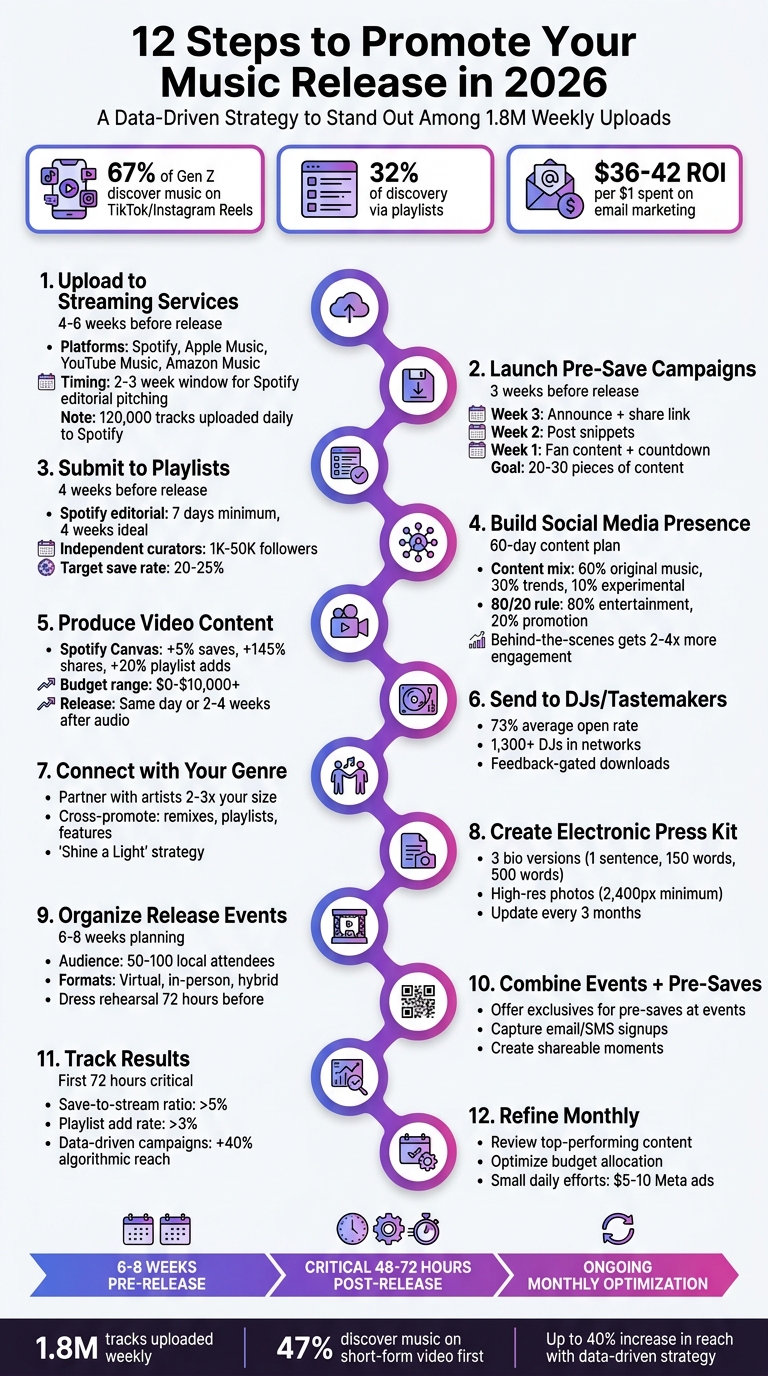
12 Steps to Promote Your Music Release in 2026
How To Promote A Single In 2026 (THE 60-DAY PLAN) MAJOR UPDATE!
sbb-itb-888513b
Step 1: Upload Your Music to All Major Streaming Services
To get your music out into the world, start by uploading it to all the major streaming platforms – Spotify, Apple Music, YouTube Music, Amazon Music, and other digital service providers. A digital distributor like DistroKid, TuneCore, Amuse, or CD Baby can handle this for you, ensuring your music reaches every platform.
Timing is everything. Upload your master at least 4–6 weeks before release. This gives enough time for processing and leaves a 2–3 week window for pitching your track to Spotify’s editorial team. With over 120,000 tracks uploaded to Spotify daily, delays can cost you valuable opportunities. This step lays the groundwork for the promotional strategies you’ll use later.
Get Your Metadata Right
Metadata might not sound exciting, but it’s critical. Mistakes like incorrect genre tags, missing mood descriptors, or inconsistent artist name spellings can limit your reach. As Florencia Flores from NotNoise explains:
"Wrong genre tags mean Spotify serves your music to the wrong audience, killing your algorithmic performance."
Be meticulous – double-check every field, from genre and mood to instrumentation and similar artists. And always use the exact same artist name across platforms to avoid creating duplicate profiles.
Prepare Visual Assets
Strong visuals can make a big difference. Design 3,000×3,000-pixel cover art that grabs attention and consider creating a Spotify Canvas – a 3 to 8 second looping video that plays during your track on mobile devices. Tracks with Canvas often see better engagement.
Once your release is live, claim your artist profiles on Spotify and Apple Music. This allows you to update your bio, upload photos, track analytics, and secure verification.
Don’t Forget Royalties
To make sure you get paid for your work, register your music with a Performance Rights Organization like ASCAP or BMI, and with SoundExchange. While distribution puts your music in stores, registration ensures you collect royalties every time your track is played.
Step 2: Launch Pre-Save Campaigns Before Release Day
A pre-save campaign is a powerful way to build anticipation and ensure your track gains traction the moment it’s released. By allowing platforms to automatically add your song to listeners’ libraries upon release, pre-saves create an instant engagement boost right when algorithms are paying the closest attention.
"Pre-saves compress listener action into the exact moment algorithms are measuring engagement most closely." – Sonikit Blog
Timing matters because streaming platforms focus heavily on save rates – the percentage of listeners who save your track to their libraries. A surge in pre-saves can help your song land on Release Radar and personalized discovery feeds, giving it a strong start.
Smartlinks simplify this process by providing a single link that directs users to their preferred streaming service, whether it’s Spotify, Apple Music, or YouTube. This eliminates the hassle of managing multiple URLs and helps track which traffic sources are driving the most conversions. Tools like Promoly make it easy to set up smartlinks and monitor performance.
To make the most of your pre-save campaign, plan it over three weeks:
- Week Three: Announce your release with behind-the-scenes content and share your pre-save link.
- Week Two: Post song snippets and insights into the production process.
- Week One: Ramp up excitement with fan-generated content and a final countdown.
Aim to create 20–30 pieces of short-form content during this time to keep your pre-save link visible across all audience segments. Sweeten the deal by offering exclusives, like early access to the track, lyric sheets, or bonus footage, to encourage more pre-saves.
Once your pre-save campaign sets the stage with a strong first-day signal, you’ll be ready to take the next step: connecting with playlists and music curators to expand your reach.
Step 3: Submit Your Music to Playlists and Curators
Getting your music featured on the right playlists can dramatically expand your audience. Spotify editorial playlists are the ultimate goal – they’re curated by Spotify’s in-house team and can introduce your tracks to millions of listeners. To get considered, you’ll need to submit through the Spotify for Artists portal, and here’s the catch: you can only pitch unreleased tracks. Why? Editors prefer to build buzz from the very beginning [24,25].
Timing matters. Submit your track at least 7 days before your release date, though aiming for 4 weeks in advance gives you the best chance of being reviewed by Spotify editors [4,25]. Your pitch is limited to 500 characters, so make it count. Skip the clichés like “genre-defying” and focus on specifics. Share the story behind the song – mention your inspiration, any sync deals, upcoming tours, or even early audience feedback [24,25].
Before you hit submit, double-check your metadata. Accurate details help both algorithms and human curators understand your music better.
Reaching Out to Independent Curators
Independent curators – those managing playlists with 1,000 to 50,000 followers – are another great avenue to promote your music. When reaching out, personalization is key. Mention the playlist by name and explain briefly why your track fits their style. Keep your message under 150 words and include a direct Spotify link to your song. If you don’t hear back, it’s okay to follow up once after a week.
Avoid Paid Placement Services
Be cautious of services that promise playlist placements for a fee. These often rely on bots, which can lead to your track being removed – or worse, your account being suspended [4,25]. Instead, focus on building genuine connections with curators who genuinely align with your music.
Keep an eye on your save rate – a strong rate of 20% to 25% indicates that listeners are connecting with your music. This can also help trigger Spotify’s algorithmic playlists, like Discover Weekly and Release Radar.
Once your playlist strategy is in motion, shift your focus to growing your social media presence to keep the momentum going throughout your release cycle.
Step 4: Build Your Social Media Presence
Social media has become a driving force for music discovery. By 2026, nearly half (47%) of listeners discover new songs on platforms like TikTok and Instagram Reels before they even reach streaming services. Even more striking, 75% of TikTok users eventually listen to those songs on streaming platforms. This makes having a consistent presence on social media essential – it’s what powers your streaming numbers.
To stay visible, stick to a 60-day content plan across TikTok, Instagram, and YouTube. Start teasing your release four weeks in advance, launch a pre-save campaign two weeks before, and ramp up your content efforts on release day and beyond. For example, you could post lyric videos by day 15, drop the official music video by day 29, and create an "Open Verse Challenge" by day 36.
On TikTok, focus on creating 60–90 second "Anchor" videos that dive into the story behind your song. These longer clips set the stage for impactful 15-second snippets. On Instagram, aim for a mix of 7–15 second Reels, behind-the-scenes Stories, and exclusive content through Broadcast Channels. Broadcast Channels are particularly useful because they deliver directly to 100% of subscribers, bypassing the usual algorithm.
Use Trending Content on TikTok and Instagram
Jumping on trends is one of the quickest ways to grow your audience. Artists who align with TikTok trends experience an 11% week-over-week boost in streaming, compared to just 3% for those who don’t. In fact, 84% of songs that made it onto the Billboard Global 200 in 2024 went viral on TikTok first.
Use tools like the TikTok Creative Center to stay on top of trending hashtags, songs, and formats. Spend a few minutes each day scrolling your "For You" page to spot what’s gaining traction. When you find a trend that resonates with your style, adapt it to make it your own. In 2026, the focus is less about copying trends and more about tailoring them to reflect your genre, emotions, and personality. Also, make sure your song’s hook lands within the first 1–3 seconds of your video to grab attention right away.
On Instagram, the algorithm now prioritizes personalized topic selection for Reels. Creators who align their content with these topics see a reach increase of 40–50%. A good content strategy here might include 60% original music, 30% trending sounds, and 10% experimental or conversational posts. Don’t forget to use features like Duets and Stitches to interact with fans and boost engagement.
Mix Different Content Types
Keeping your audience engaged requires variety. A good rule of thumb is the 80/20 rule: dedicate 80% of your content to entertainment or value – like storytelling, behind-the-scenes clips, or day-in-the-life videos – and only 20% to direct promotion. Interestingly, behind-the-scenes studio content often generates 2 to 4 times more engagement than polished promotional posts.
Maximize your reach by repurposing one 60-second "Anchor" video into 5–10 shorter clips for platforms like TikTok, Instagram Reels, and YouTube Shorts. Use Instagram Stories daily for quick updates, countdowns, and fan interactions. And keep in mind that over 80% of Instagram Reels with sound enabled are watched by users, with an average engagement rate of 2.46%.
Lastly, take the time to respond to DMs and comments whenever possible. These personal interactions can transform casual listeners into loyal fans. In a world saturated with AI-generated content, raw and genuine moments often outperform highly polished promotional clips. Let your personality shine through.
Once your social media presence is buzzing, you’ll be ready to focus on creating standout video content in the next step.
Step 5: Produce Video Content for Your Release
By 2026, video has become a cornerstone of music discovery. Platforms like YouTube, the second-largest search engine globally, make video an essential tool for connecting with listeners. In fact, 47% of listeners now discover new music on short-form platforms like TikTok and Instagram Reels before it even reaches streaming services. These platforms have essentially taken over the role radio once played in introducing audiences to fresh tracks. On top of that, video content can boost your track’s performance on streaming platforms. For instance, Spotify Canvas increases track saves by 5%, shares by 145%, and playlist adds by 20%.
"A music video is a separate asset with its own lifecycle, algorithms, and audience." – Orphiq
A single video shoot can go a long way. It can yield a full-length music video, short-form clips for social media, behind-the-scenes footage, Spotify Canvas loops, and even press images. This approach ensures you get the most out of your investment. Here’s a quick breakdown of what different types of video projects might cost:
- Lyric videos/visualizers: $0–$500
- Performance videos: $500–$2,000
- Multi-location shoots: $2,000–$10,000
- Full productions with VFX: $10,000+
Timing matters. To maximize impact, consider releasing your video on the same day as your audio. Alternatively, delay the video release by 2–4 weeks to create a second promotional wave. A popular strategy among artists is to drop the audio on a Friday and follow up with the music video on Tuesday or Wednesday, creating two distinct moments to capture attention. After the main video launch, maintain momentum by rolling out additional content like lyric videos, acoustic versions, or behind-the-scenes footage 2–4 weeks later.
"A music video without a promotion strategy is like a billboard in the desert." – Florencia Flores, NotNoise
Incorporating video into your release plan not only strengthens your social media presence but also enhances engagement on streaming platforms. These assets will also play a key role in your next step: reaching out to DJs, tastemakers, and curators.
Step 6: Send Your Music to DJs and Tastemakers
Once you’ve nailed your streaming and social strategies, it’s time to connect with key industry players. Sharing your music with DJs and tastemakers can amplify your release, exposing your tracks to thousands of listeners through live sets, radio shows, and social media. The tricky part? Reaching them efficiently while keeping tabs on their responses.
Promoly makes this process quick and seamless. You can upload your tracks, include artwork, and send out promos in under a minute. Its UPC auto-fill feature pulls metadata directly from streaming platforms, saving you time and effort. Once your promo is live, you can track opens, plays, and downloads through an intuitive dashboard.
"It takes about one minute to start and send a campaign but still has everything you need." – TJ Flanders, Never Say Die Records
Promoly also offers access to its Tastemaker Network, which includes over 1,300 DJs who have opted in to receive new music. You can refine your recipient list by genre, region, or past engagement. On average, Promoly’s promo mailouts achieve an impressive 73% open rate.
A standout feature is the feedback gate, which requires DJs to rate and comment on your track before they can download it. This ensures you receive meaningful feedback rather than being left in the dark. Plus, automated follow-ups handle unopened promos, sparing you the hassle of manual reminders. Promoly even offers a 7-day free trial, allowing 150 sends without needing a credit card.
With DJs and tastemakers on board, you’re ready to take the next step: connecting directly with others in your genre in Step 7.
Step 7: Connect with Others in Your Genre
Building relationships with artists, bloggers, and influencers can create opportunities for long-term collaboration. The secret? Start by supporting others instead of diving straight into a pitch. Engage with the content of artists you admire – share their posts, leave thoughtful comments, and create playlists that mix their music with your own.
When reaching out to journalists or bloggers, make it personal. Reference specific articles they’ve written that resonated with you, and build these connections well before your release. The same goes for fellow musicians: interact genuinely with their work before proposing a collaboration. When you do suggest working together, be specific – like saying, "I have a track that would pair perfectly with your vocal style."
For cross-promotion, partner with artists whose audience size is within 2–3 times your own. Ideas include trading featured verses, doing remix swaps, or curating playlists together. A great example of this strategy in action is Sony Music’s 2025 campaign for The Script. They filmed content at the original location of their hit song, “The Man Who Can’t Be Moved,” with frontman Danny O’Donoghue sharing creative insights. This nostalgia-driven approach earned over 4 million TikTok views and boosted the band’s Spotify monthly listeners by 50%.
Another effective approach is the "Shine a Light" strategy: publicly acknowledge your producers, mixers, and co-writers. This not only fosters goodwill but often leads to mutual support. You can also propose value-first exchanges, such as offering backstage access, meet-and-greets, or merchandise swaps, instead of simply asking for playlist placements.
To organize your outreach, think in three tiers:
- Tier 1: Major outlets like Pitchfork or Rolling Stone (usually best tackled with professional PR).
- Tier 2: Genre-specific blogs and influencers, where personalized emails referencing their past work can make a big impact.
- Tier 3: Local media and niche forums, where direct community engagement is essential.
Keep in mind that 32% of music discovery happens through editorial and algorithmic playlists. With 1.8 million new tracks uploaded weekly, a strong network can set you apart.
Once you’ve built these connections, you’ll be ready to focus on creating and sharing your electronic press kit in the next step.
Step 8: Create and Share Your Electronic Press Kit
Your electronic press kit (EPK) serves as your digital resume for industry professionals. In 2026, the standard format is a web-based EPK – PDF attachments are outdated. Industry pros typically spend just 30 to 60 seconds scanning an EPK, so it’s crucial to make it easy for them to access streaming music and videos without needing to download files. A well-crafted EPK not only reinforces the digital presence you’ve built but also adds credibility to your outreach efforts.
Start by writing three versions of your artist bio, all in the third person so that journalists can easily copy and paste them into articles. These should include:
- A one-sentence elevator pitch.
- A 150-word short bio.
- A 500-word full bio.
Next, include high-resolution press photos (minimum 2,400px) in various formats: landscape, portrait, and live performance shots.
Embed two to three of your best tracks using Spotify or SoundCloud players, and include at least one high-quality live performance video. For festival organizers, raw live footage often carries more weight than a polished music video.
"Most EPKs fail because they include everything the artist wants to say rather than everything the recipient needs to know." – Orphiq
Your EPK should also feature specific social proof and streaming stats. Instead of vague claims like "growing fanbase", highlight concrete achievements such as "150,000 organic streams in the first month." Include notable press quotes, key performances, and other milestones. Additionally, add technical assets like a professional stage plot and technical rider to show you’re ready for large-scale events. Make all assets downloadable via a cloud storage link (e.g., Google Drive or Dropbox) so press and radio professionals can easily access high-resolution photos and broadcast-quality WAV files.
When it’s time to share your EPK, adjust your approach based on your audience. For example:
- Music blogs: Send your EPK 4–6 weeks before a release, along with a brief, personalized pitch.
- College radio: Provide direct download links for broadcast-quality WAV files (16-bit, 44.1 kHz).
- Festival organizers: Submit your EPK 6–9 months in advance, focusing on your audience draw and market data.
Lastly, keep your EPK current. Update it every three months to remove old tour dates, refresh your stats, and ensure all links are active.
With a polished and targeted EPK, you’ll be ready to make a strong impression and expand your promotional reach.
Step 9: Organize Release Events and Performances
Adding release events to your promotional efforts can transform your music launch into something truly memorable. These events take your music from a solo listening experience to a shared moment, creating buzz and excitement around your work. Plus, live performances remain a top income source for most musicians in 2026, offering not just financial opportunities but also a way to build deeper connections with your audience.
"Releasing a record, EP, or single is no longer enough to cut through the noise. Live events create urgency, communal excitement, and direct paths for monetization." – Alex Mercer, Senior Editor & Live Events Strategist, Playful
To make your event successful, start planning 6–8 weeks in advance. This timeline allows you to lock in ticket sales, garner press attention, and attract sponsorships. Begin by focusing on a local audience of 50–100 attendees before expanding to a regional scale. The format of your event should align with your goals. For example:
- Virtual livestreams are great for global reach with minimal costs.
- In-person listening parties create a closer, more intimate experience for superfans and press.
- Hybrid events combine both, offering extras like backstage streams or virtual VIP rooms for remote participants while keeping the in-person energy alive.
To make the most of your audience, divide them into three key groups – core superfans, casual listeners, and industry professionals – and tailor the experience to each.
- Core superfans love exclusivity, so offer perks like early access or limited-edition merchandise.
- Casual listeners are drawn to shareable moments, such as photo opportunities, surprise guests, or interactive activities they can post on social media.
- Industry professionals need a polished presentation and a clear story about your music and brand.
For virtual events, keep things engaging with features like chat-triggered visuals, audience polls, or unlocking new tracks when certain goals are met. These strategies keep your audience involved and excited throughout the event.
Don’t skip the logistics! Run a full dress rehearsal 72 hours before the event to test all your equipment and ensure everything runs smoothly. For virtual and hybrid events, a high-speed wired internet connection is a must. After the event, act quickly – release a highlights reel and offer limited-time merchandise bundles within 24–72 hours to keep the momentum going.
Timing is everything. Spotify pays close attention to activity on your tracks in the first 48 hours after release, so plan your event to boost saves and shares during this critical period.
Step 10: Combine Event Campaigns with Pre-Save Strategies
Pairing your release event with a pre-save campaign is a smart way to turn live energy into measurable fan engagement. While events create buzz and shareable moments, pre-saves translate that excitement into actions that platforms like Spotify can track, potentially boosting your visibility through algorithms.
When done together, these strategies amplify both short-term excitement and long-term listener data. Think of it as a cycle: your event sparks emotional connection and social media buzz, while your pre-save campaign captures that momentum and channels it into actionable data. For instance, Warner Music Central Europe took this approach with Ed Sheeran’s album promotion. Surprise pub shows and pop-up performances in Germany, including a piano pop-up in Stuttgart, led to 156 million views from fan-shared content online. Imagine pairing such moments with pre-save calls-to-action – it’s a powerful way to engage fans when they’re most excited.
Take advantage of your event to incentivize pre-saves. At in-person gatherings, you can offer perks like early access to unreleased tracks, exclusive lyric sheets, or behind-the-scenes footage in exchange for email or SMS signups. A great example of this is The Cure’s Songs of a Lost World campaign in September 2024. They used creative tactics like cryptic posters, UV-light-readable postcards, and password-protected 3D album art to build intrigue. This approach drove over 55,000 WhatsApp group signups.
Platforms like Promoly make it easier to merge event campaigns with pre-save pages. They help you capture fan data, track which actions lead to pre-saves, and grow your own audience database. With around 120,000 tracks uploaded to Spotify daily in 2026, having a data-driven strategy is crucial to stand out.
"Pre-saves don’t build relationships – Spotify owns that data, not you. If you’re going to ask fans for something, make it count: join your email list or text list." – Ariel Hyatt, Founder, Cyber PR
Step 11: Track Results and Improve Your Approach
Once your release is out, tracking its performance is what transforms random guesses into actionable insights. With your multi-channel strategy in place, real-time tracking allows you to tweak and refine your promotional efforts. The first 72 hours after release are especially important – this is when metrics like stream velocity, save rates, and playlist additions can determine whether platforms like Spotify’s Release Radar will spotlight your track.
Tools like Promoly’s Campaign Dashboard and Snapshot Stats offer detailed, instant insights into how your audience is engaging with your music. You can monitor click-through rates, track how many casual listeners convert into fans, and even see whether your traffic is organic or paid. This granular data helps you spot potential red flags – like bot activity that could harm your algorithmic reach – and focus on strategies that foster genuine engagement.
"Real-time data isn’t just a report card; it’s a compass. Monitoring campaign performance as it happens allows you to steer your strategy toward what’s actually working." – Artist.Tools
Take time to review your results monthly. Look for trends in your top-performing content, platforms, and budget allocations. Metrics like a save-to-stream ratio above 5% and playlist add rates over 3% signal to algorithms that your music has traction. When you see these numbers, consider increasing your ad spend to amplify the momentum. If a specific TikTok sound or playlist is driving most of your traffic, shift your focus to creating more content around that success.
Another key metric to track is your Audience Acquisition Cost (AAC). Divide your campaign spend by the number of new followers gained to see if you’re getting a good return on investment. Even small tweaks – like optimizing your Spotify bio with 3–5 relevant keywords – can boost search-driven traffic by up to 70%. Data-driven campaigns can also improve your algorithmic reach by as much as 40% in the first week, turning your release into a well-planned launch instead of a gamble. Use these insights to keep your strategy sharp and your promotional approach adaptive.
Conclusion
Promoting your music in 2026 means weaving together digital tools, creative content, and data analysis into one cohesive strategy. The 12 steps outlined here act as a "promotion stack", with each element boosting the others. Social media sparks discovery, smart links gather listener insights, playlists drive streams, and email marketing builds momentum for release day. When combined thoughtfully, this approach turns a music release into a calculated launch rather than a gamble.
The stats back this up. 67% of Gen Z discover music through short-form videos on platforms like TikTok and Instagram Reels, while 32% of all music discovery comes from editorial and algorithmic playlists. Meanwhile, email marketing generates an impressive $36 to $42 for every $1 spent. With 1.8 million new tracks uploaded weekly in 2026, simply uploading your music and hoping for the best is no longer enough.
Sustaining a music career requires more than just great songs – it’s about connecting with the right audience at the perfect time. Start planning 6–8 weeks before your release, focus heavily on the critical first 48 hours after launch, and use data insights to fine-tune your approach monthly. Key metrics like save rates, playlist adds, and engagement signals are vital for triggering algorithmic growth. Even small, consistent efforts – like posting behind-the-scenes content three times a week or running $5 to $10 daily Meta ads – can add up to big results over time.
Treat each release as a strategic business investment. Use the strategies outlined here to build a multi-channel promotion plan, stay flexible as platforms evolve, and remember that coordinated, data-driven campaigns can increase your algorithmic reach by up to 40% in the first week. Focus on two or three channels, commit for six months, and let the data guide your next steps. The real difference between 100 streams and 10,000 streams often comes down to the strategy behind the music. By embracing a multi-channel, data-focused approach, you can turn every release into a calculated success.
FAQs
What should I do if my release gets delayed after I’ve started pitching and pre-saves?
If your release gets delayed after you’ve already pitched it and set up pre-saves, it’s important to realign your promotional efforts with the new release date. Start by updating all pre-release tools, including pre-save links and any scheduled social media campaigns. Adjust your playlist pitches to reflect the new timeline.
Make sure to communicate the delay clearly to your fans and professional contacts. Share updates about the new release date and provide revised links where necessary. It’s also a good idea to reschedule any press outreach to align with the updated launch.
Keeping your audience engaged during this time is key. Regular communication and updates can help sustain excitement and ensure that interest in your release remains strong, even with the adjusted schedule.
How can I tell if my streams and playlist adds are real or bot-driven?
To figure out if your streams and playlist adds are legitimate, take a close look at engagement patterns and platform analytics. Keep an eye out for unusual spikes in streams or playlist additions that don’t align with social interactions like likes, shares, or comments. Metrics such as listener retention, engagement rate, and geographic distribution can provide valuable clues. For example, sudden jumps in numbers without any signs of organic growth often hint at bot activity. Make it a habit to review your analytics regularly to ensure everything checks out.
What’s a realistic promo budget for an independent single in the U.S.?
A typical promo budget for an independent single in the U.S. in 2026 usually falls between $200 and $3,000. The specific amount largely depends on the scale of your promotional efforts and the particular services you decide to invest in.