
Most music magazine pitches fail for one simple reason: they ask too much, say too much, or don’t fit the outlet. If I want a better shot at coverage, I need to send a short email with one clear ask, one link, a release date in U.S. format like Aug. 3, 2026, and one line that shows I know the publication.
Here’s the full point of this guide in plain English:
- I get 5 pitch types: new single review, premiere request, interview, feature/profile, and follow-up
- I keep most pitch bodies around 51–150 words, a range tied to a 7.13% response rate
- I answer 3 questions fast: Who is this? What is coming out? Why does it fit here?
- I use one private streaming link, not attachments and not a pile of links
- I send each pitch at the right time:
- 10–14 days before release for many single reviews
- 3–4 weeks early for many premiere and interview asks
- 4–6 weeks early for features around an EP or album
- 5–7 business days later for a review follow-up
This article is useful if I’m an artist, label, or publicist trying to pitch U.S.-based online music outlets. The main idea is simple: short, direct, outlet-specific emails get more attention than mass copy-paste messages.
Quick Comparison
| Template | Best for | Main ask | When to send |
|---|---|---|---|
| New Single Review | A new track that needs a write-up | Review or new music roundup | 10–14 days before release |
| Premiere Request | An exclusive first stream or video post | One-outlet-only premiere | 2–4 weeks before premiere date |
| Interview | A release with a story behind it | Q&A, phone, or Zoom interview | About 3 weeks or more ahead |
| Feature / Profile | A bigger artist story | Profile, spotlight, or scene piece | 4–6 weeks before release |
| Follow-Up | No reply to first pitch | Short check-in with new info | 48 hours to 10 business days, based on ask |
The bottom line: if I match the pitch type to the coverage I want, keep the email tight, and make the fit obvious, I give editors an easier yes.
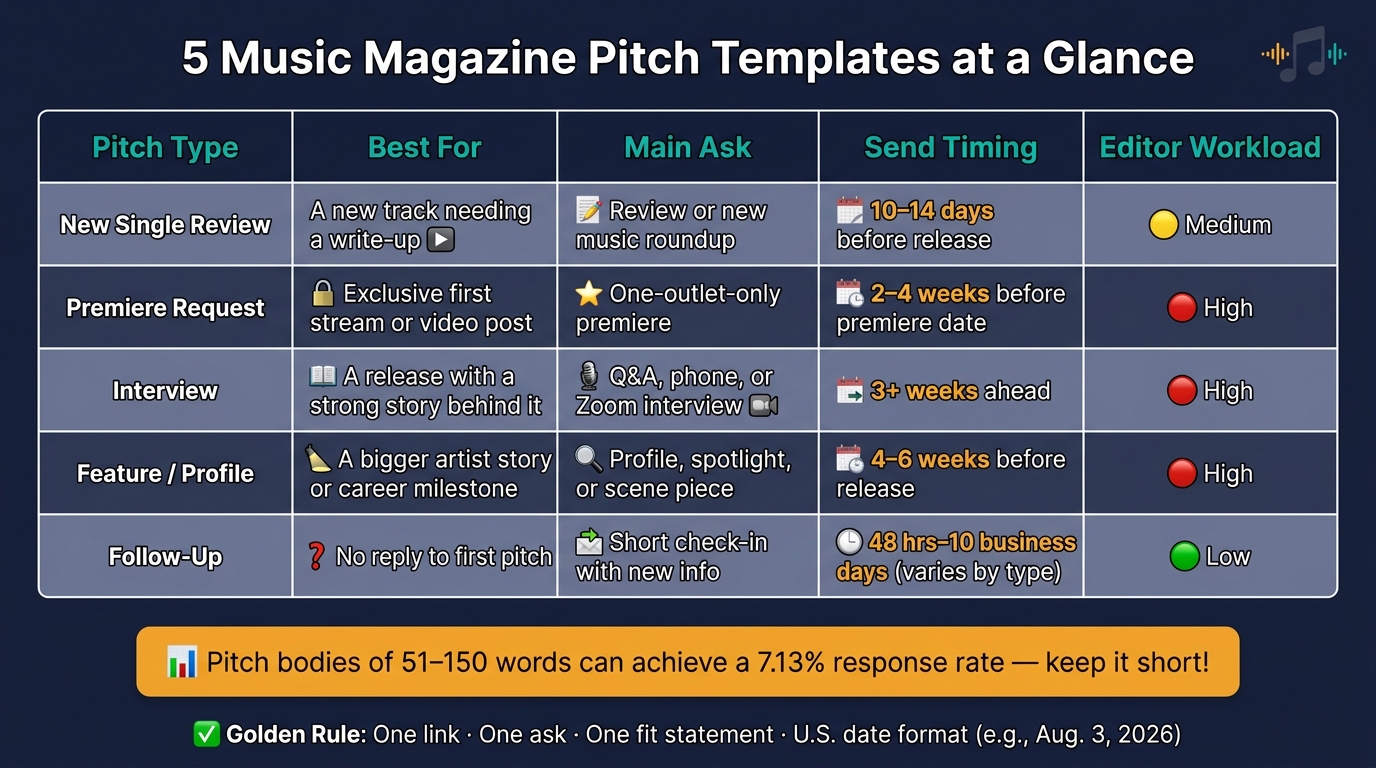
5 Music Magazine Pitch Templates: Quick Reference Guide
How to get your music on blogs and in magazines | 7 PR tips
sbb-itb-888513b
What Music Magazines Look for in a Pitch
Editors move fast. Most of them want to scan a pitch in less than a minute and answer three things right away: Who is this? What are they releasing? Why does it belong here?
One PR roundup found that pitch bodies in the 51–150 word range can hit a 7.13% response rate, which is much higher than longer emails. That alone is a good reason to keep your pitch short.
Every pitch should include these core pieces:
| Element | What to Include |
|---|---|
| Recipient name | The editor’s or writer’s actual name – never "Hi there" or "To whom it may concern" |
| Artist and release name | In the subject line and the first sentence |
| Genre and subgenre | e.g., "indie rock / dream pop" – use specific terms, not vague labels like "genre-bending" |
| Release date | U.S. format only: Aug. 3, 2026 – never 08/03/26 |
| One private streaming link | A single, click-and-play link – no attachments |
| Short bio | 2–3 sentences: city, sound, one or two notable points |
| Press kit link | Bio, high-res photos, artwork, credits, and prior coverage – all in one place |
| Fit statement | One sentence referencing the outlet’s recent coverage or a column |
Use these basics to shape the templates below.
The fit statement is where a lot of pitches miss the mark. It’s the part that shows you did your homework. A line like "I saw your recent coverage of Snail Mail and your indie rock reviews column – this single sits in that space" tells the editor this wasn’t sent to 200 people at once.
Without that line, even a polished email can feel like a copy-paste blast.
"A named pitch to the journalist who covers your style gets read. A submission to a generic inbox often doesn’t." – Promoly
For formatting, stick to U.S. style. Use spellings like favorite and catalog. Write dates as Aug. 3, 2026. Format numbers with commas, like 15,000 monthly listeners. These are the nonnegotiables. The templates below show what this looks like in practice.
1. New Single Review Pitch
Best use case
A review pitch has one job: help an editor hear the song fast and understand why it belongs in their section.
Use this template when your single is already live or coming out soon, and you want a written review or short write-up in a new music section, roundup, or track-of-the-day column. It works especially well for emerging artists. You may not have the story depth for a full interview yet, but you can still get attention through critical coverage and discovery-focused write-ups.
Core assets to include
Include:
- A private or unlisted streaming link
- Artist name
- Track title
- U.S. release date
- Genre
- A brief "for fans of" comparison
- A press kit with bio, photo, artwork, and prior coverage
Once you have those details ready, be direct about what you’re asking for.
Primary editorial ask
Put the ask near the top of the email in one clear sentence. For example: "I’d love to submit ‘[Song Title]’ for consideration in your new music section or weekly review column."
If the outlet has a named feature, like "First Listen" or "New Tracks", mention it directly. That small touch shows you’ve read the publication, and it gives the editor an easier way to place your pitch.
Ideal send timing
Send review pitches 10–14 days before release. Major outlets may need three to four weeks, while smaller blogs often need one to two weeks. If the single is already out, pitch it within the first two to four weeks.
If you’re doing outreach at scale, Promoly can send secure promo links and track opens, plays, and downloads in real time. That gives you a clear read on timing and helps you plan the next template in your outreach cycle.
2. Premiere Request Pitch
Best use case
A premiere request pitch gives one outlet the exclusive first stream or first look at your track or video before it appears anywhere else.
Use this pitch only for outlets that already post premieres or first-listen features.
It fits best when you’re pitching:
- a new single
- a music video debut
- a visualizer
- a key album track with a clear story behind it
The angle matters a lot here. If there’s a strong story behind the release, the pitch is much easier to place.
One more thing: send the same premiere to only one outlet at a time. If you offer the same exclusive to a few outlets at once, you can hurt your credibility.
Core assets to include
Keep the package tight. Include:
- one private streaming link
- a short bio or EPK with photos
- artwork and key credits
- one or two lines that explain the premiere angle
Primary editorial ask
Be direct. Put the ask in both the subject line and the first line of the email.
A subject line like "Premiere request: [Artist] – [Song Title] (out [Release Date])" tells the editor right away what the email is about.
Then spell out the offer in one sentence: "I’d love to offer [Outlet Name] the exclusive premiere of [Title] on [Date]."
Also say exactly what the outlet would be publishing with the premiere. Don’t make them guess.
Ideal send timing
Try to pitch 3–4 weeks before your target premiere date for major online outlets, and 2–3 weeks ahead for smaller blogs and niche sites.
Make sure all final assets are ready before the outlet locks in the date.
If the outlet needs more room for context than a premiere post usually gives, use the interview pitch below.
3. Interview Pitch
Best use case
Use an interview pitch when a release needs more than a first listen. This works best when the artist has a timely story tied to the music, not just a new drop. Think along the lines of a new album or EP cycle, a tour kickoff, a label signing, or a backstory that connects with a current conversation.
"Journalists write stories. Give them an angle: a debut release, a label anniversary, a collaboration story. The music supports the narrative."
That angle gives the outlet a reason to assign the piece. Your job is to make that story clear from the start.
Core assets to include
Keep the package tight and useful. Include:
- A short artist bio of 150–250 words
- A private streaming link to the key track or project
- A link to the EPK with hi-res press photos and prior press quotes
- A few suggested talking points that match the outlet’s tone
- Clear availability in a U.S. time zone, such as "Available weekdays, 10:00 a.m.–3:00 p.m. PT."
If you have strong campaign feedback or play data, add one relevant metric in a single bullet. One sharp data point lands better than a pile of numbers.
Primary editorial ask
Lead with the interview request in the first line. For example: "I’d love to arrange a short interview with [Artist] around their upcoming EP, releasing on October 18, 2026."
Then give the editor a few format options, such as email Q&A, Zoom, or a 20–30 minute phone call. That makes the ask easier to say yes to.
It also helps to include two or three suggested interview questions. This gives the editor a fast read on the angle and shows where the conversation could go.
Ideal send timing
Send the pitch at least three weeks ahead. For major outlets, aim for 3–4 weeks. For smaller sites, 2–4 weeks is a good range.
Timing during the week matters too. Tuesday, Wednesday, or Thursday in the middle of the morning, based on the outlet’s time zone, tends to work best. Monday inboxes are often packed.
Example: "The EP releases Oct. 18, 2026, and [Artist] is available for interviews Sept. 15–Oct. 10, 2026."
4. Feature or Artist Profile Pitch
Best use case
The earlier templates are built to pitch a song, a premiere, or an interview. This one is different. It pitches the artist’s bigger story.
Use it when there’s a clear angle beyond the new release, like a career shift, a tie to a local scene, a key collaboration, or a milestone such as a debut album or label signing. A feature also has a longer shelf life than a review or premiere. It can keep building trust and name recognition over time.
This is the right template when the release needs context, not just coverage.
Core assets to include
Send a full EPK that includes:
- a short bio
- a long bio
- 2–3 hi-res photos with credits
- key tracks
- key milestones
Also add one or two specific data points as context, not as a hard sell. For example: "Over the past six months, [Artist] has grown from 10,000 to 45,000 monthly listeners, driven largely by regional touring in the Midwest." That kind of framing shows movement without sounding pushy.
Primary editorial ask
Open with the request in the first sentence. Then give one angle that lines up with the outlet’s coverage.
After that, offer one format option, such as a narrative profile, a Q&A, or an "Artist to Watch" spotlight. You can also mention that you’re open to a shorter spotlight if that works better for their editorial calendar.
Ideal send timing
Feature pitches need more lead time than review or premiere asks.
| Timing Trigger | Recommended Lead Time |
|---|---|
| Album or EP release | 4–6 weeks before release date |
| U.S. tour launch | 6–8 weeks before first show |
| Collaboration or signing announcement | 2–4 weeks before public reveal |
5. Follow-Up Pitch
Best use case
If your first pitch gets no reply, send one short follow-up instead of starting over. Stick to follow-ups only when the first note was clear and simply went unanswered. If your tracking shows the editor opened, played, or downloaded the pitch, a brief reply makes sense.
For non-urgent reviews and features, the first follow-up usually makes sense after 5–7 business days. Interviews and profiles can wait a bit longer, around 7–10 business days. If you’re pitching a premiere tied to a set release date, move faster: 48–72 hours after the first pitch is a reasonable window.
A follow-up works best when you have actual news to share. Maybe the song landed on a playlist, a tour date just dropped, or the release moved up the charts. That gives the editor a fresh reason to look again, instead of feeling like they’re just being poked.
Core assets to include
Reply in the same email thread so the editor can see the full exchange right away. That saves them from digging around and saves you from repeating yourself.
Keep it tight – under 200 words. Add the track or release link again, mention any new update in a line or two, and make the next step easy. If you can, put the stream, bio, and press photos into one smartlink so the editor can check everything in one click.
Primary editorial ask
Say what you want in one clear sentence. For example: "Would this be a fit for your weekly new tracks column?" or "Would you be open to a short review or adding this to your new music roundup?"
Also give them an easy out. A line like "Totally understand if it’s not the right fit – thanks for taking a look" helps keep things warm even if they say no.
Ideal send timing
The table below covers the most common situations:
| Coverage Type | Follow-Up Window | Max Follow-Ups |
|---|---|---|
| Review or feature | 5–7 business days after initial pitch | 2 |
| Premiere (release-date tied) | 48–72 hours after initial pitch | 1–2 |
| Interview or profile | 7–10 business days after initial pitch | 2 |
Send follow-ups Tuesday through Thursday, ideally between 8:00–11:00 a.m. local time, when open rates tend to be highest. Skip Monday mornings and Friday afternoons. Those windows are often packed with deadline triage and weekend planning.
Use the quick-reference table next to match each template to the right outreach scenario.
Quick Reference: When to Use Each Template
Use this table to line up your pitch type with the outlet’s workload and your release goal.
| Template | Primary Goal | Strongest Hook | Required Assets | Editor workload |
|---|---|---|---|---|
| New Single Review | Secure an editorial review of your new single or album | Timely release date, a strong genre match, and early buzz like press quotes or playlist support | Streaming link, short press release or one-sheet, high-res press photo, release date, and label info | Medium – requires listening time and a written review |
| Premiere Request | Land an exclusive or first-look premiere for your new track or music video | Exclusivity, plus a strong story behind the release tied to tour dates, festival appearances, or sync placements | Private pre-release link, final audio/video, artwork, proposed premiere date/time, and a short story or talking points | High – time-sensitive post with scheduling and copy prep |
| Interview | Set up an interview to spotlight your story, process, and upcoming releases | A strong artist story or timely theme editors can shape into a narrative | Artist bio, press photos, key talking points or suggested themes, and links to latest releases and notable achievements | High – interview planning, Q&A, editing, and layout |
| Feature or Artist Profile | Earn a feature article that places your work within a broader scene or narrative | Your role in a broader scene or trend, plus notable achievements that can support a long-form piece | EPK/extended bio, scene/context info, highlight tracks, key metrics, and past coverage | High – research-heavy long-form piece or scene profile |
| Follow-Up | Check in on an earlier pitch, share updates, and keep the relationship warm | New developments like tour dates, playlist adds, or updated stats that give the original pitch new life | Original pitch reference, updated stats, press quotes, or tour info, and latest links | Low – quick check-in, minimal time to review |
The editor workload column helps you choose the right pitch type fast.
Pitch Checklist and Formatting Notes
Use this final pass to tighten any of the five templates before you send them. Every pitch should include a subject line, a tailored reference, the release or story details, one link, and a clean sign-off.
A clear subject line does a lot of work up front. Something like "Review Request: Indie Rock Single ‘Hollow Ground’ – Out September 15" tells an editor what you want before they even open the email.
Keep the body between 100 and 200 words. Use short paragraphs, plain text, and subject lines under 60 characters. Editors often skim pitches on mobile first, and a long wall of text makes that harder to do.
Stick with plain text and light formatting. Skip embedded images, big logos, and multiple font colors. Those extras can trip spam filters and slow loading on mobile.
When the body is tight, limit the pitch to one link. If you drop in links to several platforms at once, editors have too many options and may not click anything. Pick one destination, label it clearly – "Stream the single here" – and place it on its own line.
If you’re sending an early or unreleased track, use a private promo link or embedded player. Promoly can host private promo links and track opens, plays, and downloads.
End with a signature that makes replying simple. Include your full name, role – artist, label rep, or publicist – city and state, such as Austin, TX, and a contact email that you check often.
Conclusion
The takeaway is simple: good music magazine pitches are short, specific, and tailored to each outlet’s editorial focus. Editors at niche outlets can receive 100–200+ pitches a day, so a concise email that makes the fit obvious will beat a generic blast.
Across all five templates, the same rule holds: customize each one to the outlet’s beat and the type of coverage you want. The three variables that matter most are the editor, the angle, and the ask. An editor should be able to see the fit and the ask in one pass.
If the first pitch gets no reply, send one polite follow-up and then move on.
Pick the template that fits the coverage goal, tailor it to the outlet, and send it only when the match is genuine. That’s the fastest path to better coverage.
FAQs
How do I choose the right pitch template?
Choose the template based on who you’re contacting and what you want from the outreach. Go with one that gives you room to show you did your homework, like mentioning the recipient’s recent work or current interests.
A strong template has three parts:
- A concise intro
- A short description of the music
- A polite, direct call to action
Promoly’s email template builder can help you put these pieces into a clean structure, whether you want a formal, casual, or hype-focused tone.
What should I do if I have no press coverage yet?
If you have no press coverage yet, don’t worry. Put your energy into credibility and real relationships instead. In your pitch, point to other wins, like:
- playlist placements
- a different approach to production
- a personal milestone
- the story behind the track
Keep your message brief, professional, and clear. Use Promoly to send streamable links instead of attachments, then follow up once, politely, after 7–10 days. If there’s still no reply, move on and try again with your next release.
How personal should each music magazine pitch be?
Personalize every pitch so it doesn’t read like a mass email. Journalists and people in the industry can spot a generic template fast. And even a small custom detail can help you get more replies.
Mention something specific about the person you’re contacting, like a recent article, playlist, or artist they featured. That shows you did your homework and makes the message feel more human. It also helps build trust.